Custom Comparison Slider
A drag-to-reveal before and after control was built rather than installed, tracking pointer and touch position and holding both images in alignment as the viewport changes.
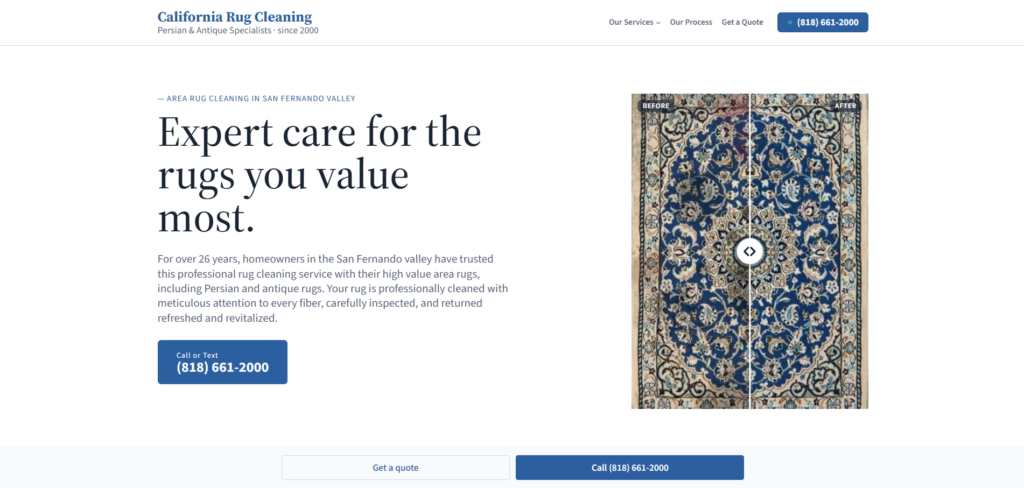
A rug restoration site built around a custom before-and-after slider, because the whole sale rests on proving the rug comes back better.
California Rug Cleaning restores and cleans rugs, and the entire sale rests on one question a customer asks before they will hand over something valuable, which is whether it will actually come back looking better.
The site answers that directly with a custom before and after slider, built rather than installed, that lets a visitor drag across a single image to reveal the same rug before and after treatment. A gallery of paired photographs makes a visitor compare two images and trust the pairing; a slider makes the change happen in their own hand, which is a different kind of proof.
Around it sits the technical and acquisition layer. Service pages are structured for local search with schema describing the business and its services as entities, and paid campaigns run against the same terms, measured on quote requests rather than on traffic.
Carries the site and the service pages, with the comparison slider built as a reusable component rather than a one-off block of markup.
Powers the before and after slider, tracking pointer and touch position to move the reveal and keeping both images aligned as the viewport changes.
Handles the templates behind the service pages and emits the structured data describing the business, its location, and the services it offers.
Describes the business and its services as distinct entities, so search engines read the offering rather than inferring it from page copy.
Structures service and location pages around how rug cleaning is actually searched for, with headings, canonicals, and internal linking to match.
Runs paid search against the same service and area terms, measured on quote requests rather than on clicks.
Carries the tracking layer, with quote form submissions and phone clicks fired as conversion events.
Measures which services and areas produce actual inquiries, so content and ad spend can follow what converts.
A drag-to-reveal before and after control was built rather than installed, tracking pointer and touch position and holding both images in alignment as the viewport changes.
Letting a visitor move the reveal themselves is more convincing than two photographs side by side, because they control the comparison instead of trusting it.
Schema describes the company, its location, and each service as entities, so search engines read what is offered rather than inferring it from copy.
Form submissions and phone clicks fire as conversion events, so both the content and the ad spend are judged on inquiries rather than sessions.